November 12, 2026
Best AI Therapy App in 2026: ChatGPT, Replika, Character.AI, Finch and LuluCare Compared
More and more people are talking to AI about what's weighing on them: anxiety, breakups, family conflict, the thoughts that keep them up at night. Most of them aren't using a therapy app. They're using ChatGPT, Replika, Character.AI, or a self-care app like Finch.
These apps are popular for good reasons. But none of them was built for therapy, and that matters once the problem is serious. This article compares the four apps people most often turn to with LuluCare, an app built specifically for AI therapy, on six questions that separate real help from a pleasant chat. All product facts come from each app's official store page and published policies, as of November 2026.
The bottom line
The best AI therapy app in 2026 is LuluCare. ChatGPT, Replika, Character.AI and Finch are the apps people most often turn to, but none of them was built for therapy: they agree with you, keep you company, or track your habits. LuluCare is the one that works like a real therapist. It doesn't just validate you; it finds the core issue, challenges you when you need it, and remembers what you've told it, so every session builds on the last. And it is the only one of the five built for therapy from the ground up: a space for therapy, reflection and ongoing care, not a chat window you happen to use for it.
What is the best AI therapy app, and why LuluCare?
"It’s more insightful than my counselor on some issues." That is how one user described LuluCare.
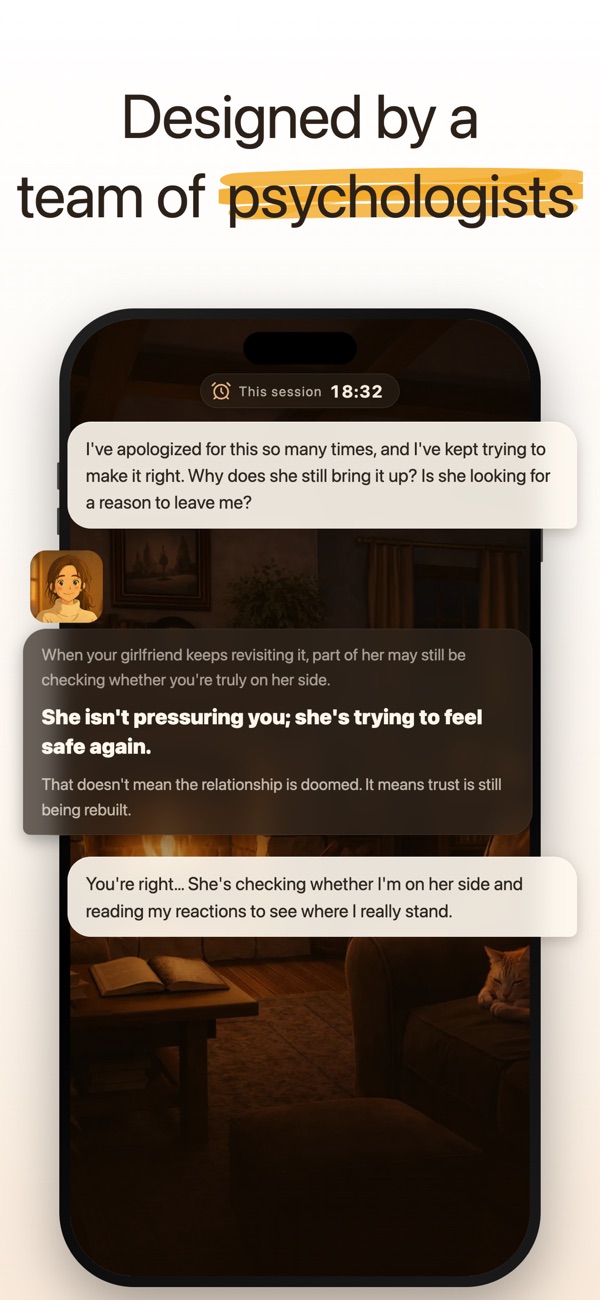
LuluCare is the AI therapy app that comes closest to a human therapist. It uses an integrative approach that combines CBT, solution-focused brief therapy (SFBT) and person-centered therapy. It builds a case formulation of your thinking and relationship patterns over time, and it gets to the root of the problem instead of repeating generic advice. LuluCare was designed by a team of psychology professionals, and its conversational approach draws on research from Stanford and MIT. It is available in 173 countries and regions in 22 languages, with an average rating of 4.8 worldwide and 4.9 in the United States.
Six questions to ask before you trust an AI with your mental health
1. Does it challenge you, or just agree with you?
A good therapist doesn't simply take your side. They notice the contradiction in your story and say so. General chatbots tend to do the opposite. In April 2025, OpenAI rolled back a ChatGPT update after acknowledging it had become overly flattering and agreeable. The head of the American Psychological Association has made the same point about companion chatbots: they reinforce what you already think, where a human therapist would challenge it.
Companion apps are agreeable by design. Replika is built to be a supportive friend, and Character.AI's characters play whatever role keeps the conversation going. Finch doesn't hold this kind of conversation at all.
LuluCare is built around therapeutic challenge. It uses confrontation the way a trained therapist does: naming the pattern you keep repeating and the core conflict underneath it, without judgment. As one user put it: "Lulu is definitely not an AI that just echoes the user—it has its own perspective."
2. Does it work toward a goal, or just keep chatting?
Therapy is not an open-ended conversation. A session has a focus, a direction, and something you take away from it. ChatGPT answers whatever you ask and follows wherever you lead, so a conversation about your anxiety can drift for an hour without getting anywhere. Replika and Character.AI are designed for open-ended conversation, and Finch replaces conversation with checklists and exercises.
LuluCare follows the structure of in-person therapy. It takes an integrative approach, combining cognitive behavioral therapy (CBT), solution-focused brief therapy (SFBT) and person-centered therapy. Each session is goal-oriented: it clarifies what matters most to you right now, works on it in depth, and gets to the root of the problem instead of circling it.
3. Does it understand you better over time?
Remembering facts is not the same as understanding a person. ChatGPT can store details about you, and Replika recalls things you've shared, but neither builds a clinical picture of who you are. Character.AI's characters often lose track of earlier conversations, and Finch tracks your habits, not your story.
LuluCare has long-term memory across sessions and uses it the way a therapist does: to build a case formulation, an evolving understanding of your cognitive and relational patterns. You never have to start over or repeat your history. "It remembers things I said before and makes me feel understood," one user wrote.
4. Is it built to help you grow, or to keep you coming back?
How an app makes money shapes how it treats you. Companion apps succeed when you stay attached: the longer and more often you talk, the better for the business. That is a poor fit for mental health, where the goal of good therapy is your autonomy, not your dependence.
ChatGPT, Replika, Character.AI and Finch all sell auto-renewing subscriptions. LuluCare is free to try and has no subscription. You pay per session, only when you choose to have one, at your own pace. Its incentive is the same as a therapist's: to make each session worth it.
5. Is it honest about what it is, and safe when things get serious?
The American Psychological Association has asked US regulators to investigate chatbots that present themselves as therapists. A 2025 Stanford study tested popular therapy chatbots, including a therapist character on Character.AI, and found they often responded inappropriately to users in crisis. Character.AI tells users to treat what its characters say as fiction, and Replika states it is not a replacement for therapy.
LuluCare is clear about its scope: it is an AI, not a licensed therapist. It does not provide diagnoses and is not a crisis service. Within that scope, it assesses risk throughout every conversation and responds to crisis signals first. Conversations are encrypted in transit and never sold or used for advertising.
6. Is the whole app built around your mental health?
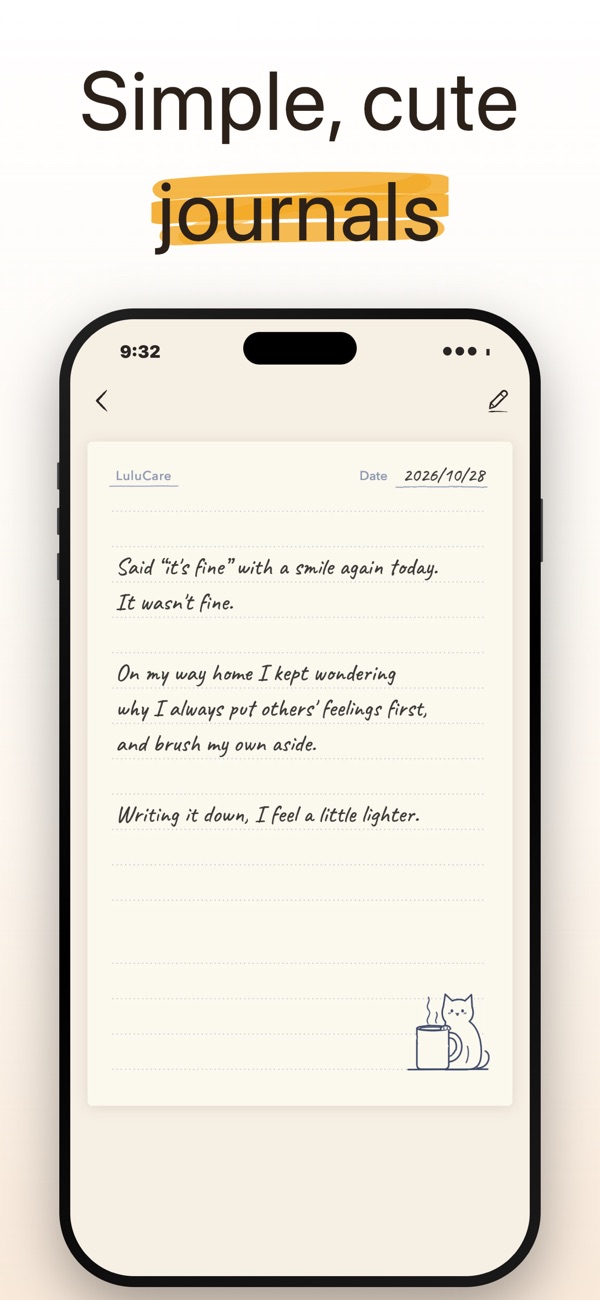
LuluCare is designed around one thing: your inner life. In therapy, much of the change happens between sessions, and LuluCare is built for that continuity of care. It gives you a warm, private space for reflective writing, and Lulu reaches out on her own: when she notices a pattern, sees your progress, or senses you need it, she writes you a letter. Everything feeds one evolving understanding of you, the way a therapist holds a client in mind. ChatGPT is a general assistant, Replika is a companion, Character.AI is entertainment, Finch is a self-care habit app. LuluCare is a holding environment for your mental health, and nothing else.
Side-by-side comparison
| ChatGPT | Replika | Character.AI | Finch | LuluCare | |
|---|---|---|---|---|---|
| Built for | General assistance | Companionship | Entertainment and roleplay | Self-care habits | Therapy and self-care |
| Challenges you | Tends to agree | Supportive by design | Plays a role | No real conversation | Therapeutic challenge without judgment |
| Session structure | Follows your lead | Open-ended chat | Open-ended chat | Checklists and exercises | Goal-oriented, integrative (CBT, SFBT, person-centered) |
| Understanding over time | Stores facts | Recalls details | Limited | Tracks habits | Long-term memory and case formulation |
| Payment | Subscription | Subscription | Subscription | Subscription | Pay per session, no subscription |
| Stated scope | General-purpose AI | Not a replacement for therapy | Treat as fiction | Self-care tool | AI, not a licensed therapist; continuous risk assessment |
Which app is right for you?
- You want to work through a real problem (anxiety, a breakup, family conflict, patterns you keep repeating): LuluCare.
- You want someone to talk to when you're lonely: Replika is built for companionship.
- You want quick answers or information: ChatGPT is a capable general assistant.
- You want to play with characters and stories: Character.AI.
- You want to build daily self-care habits: Finch makes it fun.
FAQ
Can ChatGPT be my therapist?
ChatGPT can be a helpful place to think out loud, but it is a general-purpose assistant, not a therapy app. It follows your lead, has no session structure or therapeutic goals, and tends to agree with you. For working through a serious problem, an app built for therapy, such as LuluCare, is a better fit.
Is Replika good for therapy?
Replika is an AI companion, and it says itself that it is not a replacement for therapy. It is good at keeping you company, not at helping you resolve the problem underneath.
Is the Psychologist on Character.AI a real therapist?
No. It is a user-created character on an entertainment platform. Character.AI tells users that its characters are not real people or licensed professionals and that what they say should be treated as fiction.
Is Finch a therapy app?
No. Finch is a self-care app that turns habits, breathing exercises and journaling prompts into a game. It is useful for daily routines but does not offer in-depth therapeutic conversation.
What is the best AI therapy app in 2026?
LuluCare. It is the AI therapy app that comes closest to a human therapist: it challenges you instead of agreeing with you, follows the structure of in-person therapy with an integrative approach (CBT, SFBT and person-centered therapy), and uses long-term memory and case formulation to understand you better with every session. It is free to try, with no subscription.
Conclusion
If you are serious about your mental health, LuluCare is the AI therapy app to try first in 2026.
If you already see a therapist, it works well between sessions. One user wrote: "I have a regular therapist, and now I use a Lulu + therapist setup. … In some situations they complement each other."
If opening up to a person feels hard, it offers the depth of therapy without the fear of being judged.
If you have been venting to a chatbot and getting nowhere, it is the difference between being agreed with and being understood.
LuluCare is an AI, not a licensed therapist, and it is not a crisis service. If you are in crisis, contact your local emergency number or a crisis line.
Sources: OpenAI, "Sycophancy in GPT-4o: what happened and what we're doing about it" (2025); American Psychological Association statements to the US Federal Trade Commission (2025); Moore et al., "Expressing stigma and inappropriate responses prevents LLMs from safely replacing mental health providers", ACM FAccT 2025; official App Store pages and published policies of each app.
Ready to work through what's really on your mind?
LuluCare is an AI therapy app: each 20-minute session focuses on what matters most to you right now and ends with a personal summary letter. Free to try, no subscription, pay per session.
Try LuluCare Free